Sheldwich Primary School and Little Hedgehogs Pre-School
Special Educational Needs and Disabilities
SEND Policy and Information Report
Our SENCO (Special Educational Need co-ordinator) is Mrs C Lay and she can be contacted by e-mail: office@sheldwich.kent.sch.uk or by telephone: 01795 532779
SEND Provision at Sheldwich Primary and Little Hedgehogs Pre-School
At Sheldwich Primary School and Little Hedgehogs Pre-School, we believe that all children are unique, valued, respected and welcomed whatever their educational need. We work hard to ensure that every member of our school community – pupils, parents, staff feel supported and included. Sheldwich is an inclusive school and every child, whatever their individual abilities or needs, is equally valued and welcomed here.
We recognise the importance of helping all children achieve their full potential; emotionally, socially, physically and academically. We ensure they are fully included in all school activities, seeking external support and facilities when needed.
If you have any concerns regarding your child's learning, emotional, medical or physical needs, then please speak to either your class teacher or Mrs Lay (Assistant Headteacher and SENCo) to discuss your concerns.
For further information please see our SEND policy (attached above).
SEND = Special Educational Need and Disability
How the curriculum is matched to meet children's needs
We believe that all pupils will be able to access the curriculum at a level appropriate for their individual needs. Class teachers plan carefully to ensure that lessons are differentiated appropriately to suit the learning needs of all pupils, to enable success. The 'Class Provision Map' outlines more specific support for children, either on an individual or group basis and is reviewed and adapted during pupil progress meetings. A few children that have needs which are more complex will receive personalised 1:1 teaching, that is often monitored or directed by external services. Children with the most complex needs, will have been awarded an Education and Health Care Plan (EHCP) by the Local Education Authority and will have their own Provision Plan. This plan is a legal document and specific targets must be implemented and monitored to ensure that progress is made, and the child’s needs are met. All support is assessed and adapted accordingly using the ‘Plan, Do, Review’ cycle.
Sheldwich is a very friendly and open school and pre-school. We value the importance of building positive relationships with parents, families and our local community. If your child is identified as having SEN-D, meetings take place on a formal and informal basis, as our door is always open to the concerns of parents. We formally hold two parents evenings a year alongside with two formal reports being written to communicate successes and next step targets; children and parents are encouraged to take an active part in the delivery and planning of support, and training/advice can be offered or sourced as necessary.
We believe all children are entitled to the same access to extra-curricular activities, and are committed to making reasonable adjustments to ensure participation for all.
Little Hedgehogs Pre-school and Sheldwich Primary School are fully compliant with DDA (Disability Discrimination Act) requirements. All buildings and outside areas have easy access. There is one disabled toilet and we ensure that wherever possible equipment used is accessible to all children regardless of their need.
Specialist services or expertise that are available at or accessed by Sheldwich Primary School and Little Hedgehogs Pre-school
At Little Hedgehogs Pre-School and Sheldwich Primary School we are able to approach Specialist Teaching Services for advice and support with children who have a variety of Special Educational Needs, through a referral to LIFT (Local Inclusion Forum Team). Children in Little Hedgehogs, Class R and children with an EHCP have access to Speech and Language Therapy Service (SALT). Through referral, we also access Occupational Therapy, the School Nursing Team, Early Help, Paediatricians, CHYPMHS (Children and Young Person Mental Health Service). We can also help with private referrals for assessment of Dyslexia/Dyscalculia. We are able to fund support from a Well-being Support Worker and assessments by an Educational Psychologist for the children with most need, in order to understand what support is needed for an individual child.
Details of KCC SEND Provision (Local Offer) can be found here: https://www.kent.gov.uk/education-and-children/special-educational-needs
Staff Training to Support Children with SEND
Autistic and Dyslexia friendly classroom practices are reflected throughout the whole school. Staff are supported to ensure they are meeting the needs of dyslexic and autistic children and we seek advice from a specialist teacher where appropriate. The skills and knowledge of Class Teachers and Learning Support Assistants are updated during staff meetings with the SENCO/Subject Leaders. Training to date has covered: Autistic Spectrum Disorders, Attention Deficit (Hyperactivity) Disorder, Language for Learning, Dyslexia, Dyscalculia, Dyspraxia (difficulties with fine and gross motor skills), Lego Therapy, Sensory Processing, Auditory Memory, Selective Mutism, Well-being and SALT.
Supporting, speech, language and communication (SLC) at Sheldwich Primary School
Speech, language and communication are essential life skills. They are linked to learning, attainment, behaviour, social and emotional development, and mental wellbeing.
The Balanced System® is used in Kent to help everyone work together to support pupils’ speech, language and communication, and this includes us working in a more joined up-way with the speech and language therapy service.
We have an allocated link speech and language therapist from the NHS who we meet with regularly to help us plan and improve our support for speech, language and communication across the school. They also work with individual pupils or groups as needed. Our link therapist is Thomas Wiffen and your child may see them in class or around school.
Our school is committed to achieving the following outcomes, known as the ‘Five Strands’ of the Balanced System®:
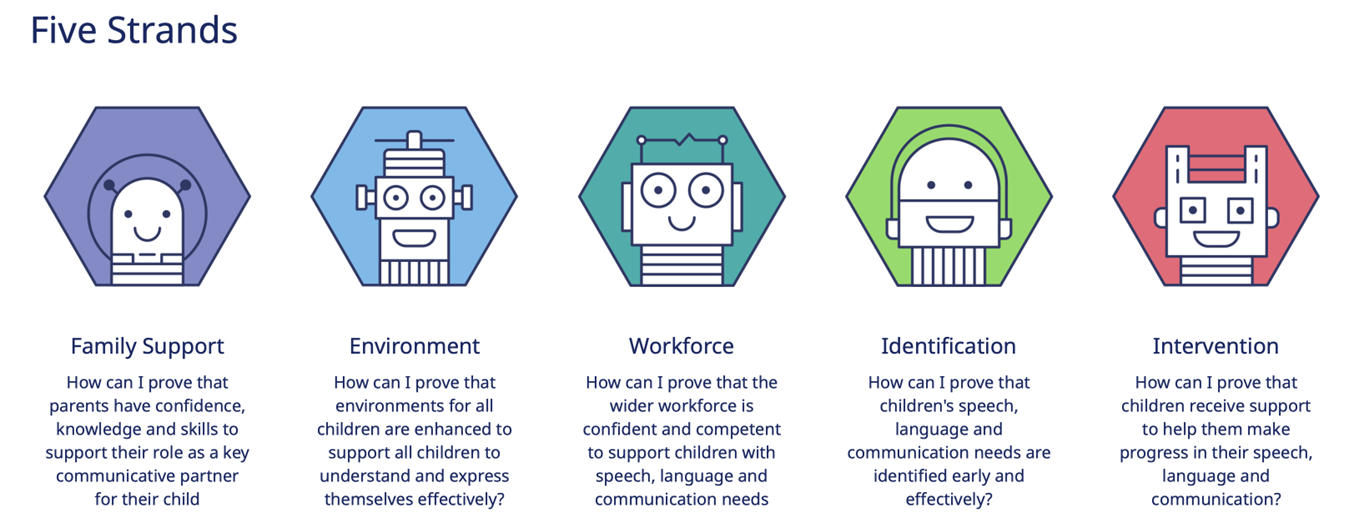
- Family support: Parents have the confidence, knowledge, and skills to support their child's speech, language and communication; and pupils can make pro-active choices about their support.
- Environment: classrooms and other places in school are set up to help pupils to understand and express themselves effectively.
- Workforce development: our staff know how to support pupils with their speech, language and communication.
- Identification: speech, language and communication needs are identified early and effectively.
- Intervention: pupils get the help they need to make progress with their speech, language and communication.
In each strand, there are three levels of support:
- Universal Support: Helps all pupils with speech, language and communication. For example, staff using visual aids to enhance understanding in class.
- Targeted Support: Assists pupils with speech, language and communication needs (SLCN) or those at risk. For example, pre-teaching vocabulary and small language groups.
- Specialist Support: For more complex SLCN requiring individualised approaches. For example, therapy for a child with a complex speech sound disorder.
Pupils may need support at several levels simultaneously, and this can change over time. For instance, specialist support might be helpful at certain points, but pupils will also receive universal and targeted support.
For more information about the Balanced System® in schools and how speech and language therapy services are working, visit KELSI.
Concerns about your child’s speech, language and communication skills
If you have any concerns about your child’s speech, language or communication skills, please speak to your child’s class teacher first. We will then work together to agree on the next steps.
If necessary, we may discuss your child’s needs with our link therapist and develop a plan. You will be kept informed about any plans to support your child.
An important principle of the Balanced System® is ensuring that what matters most to you and your child is central to agreeing on outcomes and setting targets.
Useful websites for parents (schools to select as appropriate):
Speech, language, and communication needs - Kent County Council (general information about SLCN in Kent including how to access support)
The Pod - KCHFT – (information and resources including workshops delivered by Kent speech and language therapists)
BBC Tiny Happy People (advice and activities for all parents to support speech, language and communication development, up to age 5).
Home - Speech and Language UK: Changing young lives (national charity, lots of information on typical development, resources and advice translated into different languages)
SLCN - Afasic (national charity – information and resources)
RADLD - Raising Awareness of Developmental Language Disorder - RADLD
Parent Portal - Speech and Language Link (information about development and activities to support including for teenagers)
Words for Life | National Literacy Trust | Words for Life (parent advice to support language, literacy and communication for up to 12 years)
Zone In | Words for Life (Tips on boosting reading, writing, speaking and listening skills for young people age 14+)
The Balanced System® in Kent for Speech Language and Communication Needs (SLCN) – KELSI (information aimed at schools and professionals, but may be of interest to parents wanting to understand how the Balanced System works in more detail)
Preparing For Transition
Transition is a part of life for all learners, whether that involves moving to a new class or moving to a new school. We recognise that transition can be an unsettling time for all children, but especially so for a child with SEND. Consequently, we work closely with parents, pupils and staff to ensure these transitions run as smoothly as possible.
Class R staff carry out visits to nursery settings, prior to children starting our setting or school. Concerns about particular needs are brought to the attention of the SENCO. Where necessary the SENCO arranges a further meeting with parents, previous setting etc.
Class teachers of children joining from other schools will receive information from the previous school; if required the SENCO will telephone previous school to discuss individual pupil’s needs.
Planning for transitions within the school will take place in the Summer Term; arrangements for transition to Secondary School for pupil with SEND will be planned according to individual need and the receiving school.
Useful SEND Support Websites
Specific Learning Needs
Dyslexia
Dyspraxia
Irlen Syndrome information
Social Communication Needs
Social, Emotional and Mental Health
Language Needs
Physical Disabilities